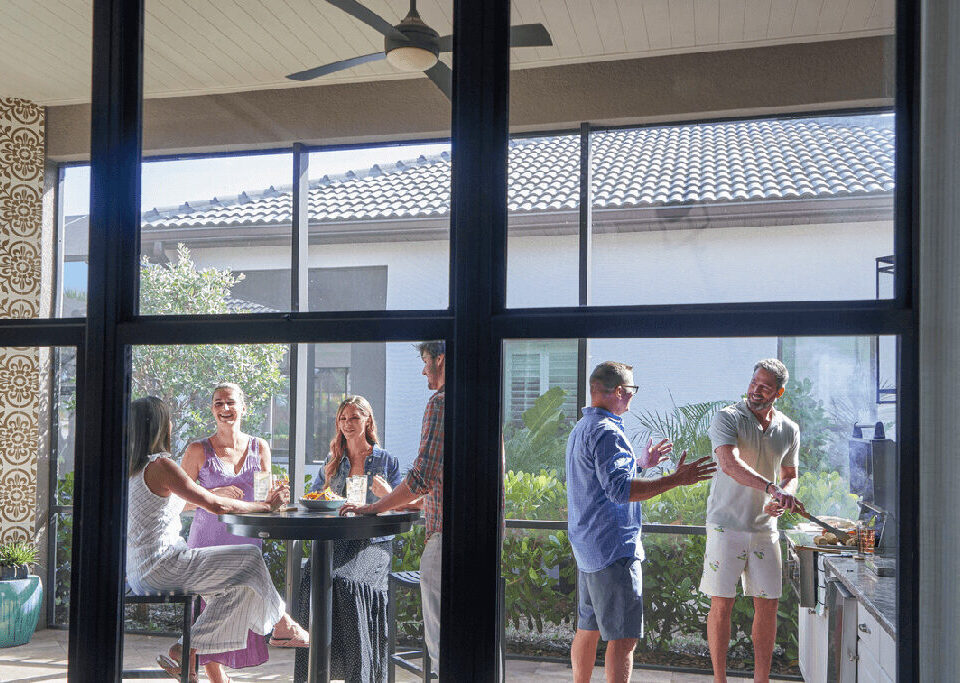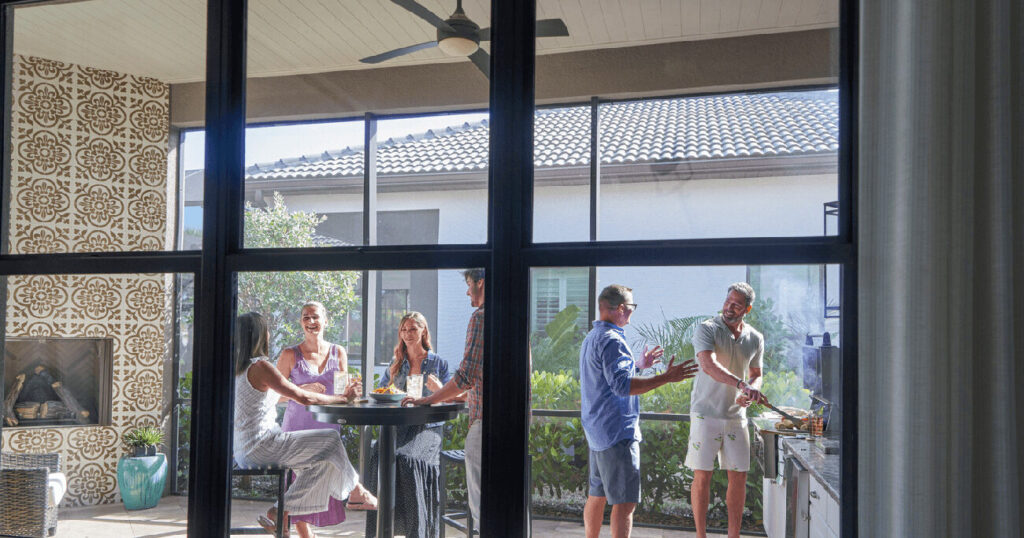
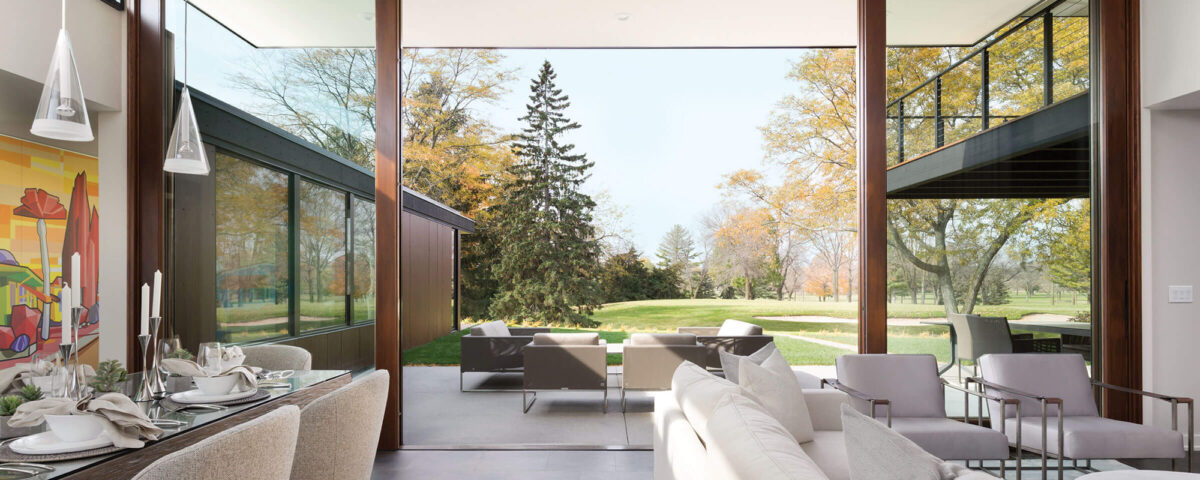
The best patio door for a Florida home isn’t a single model. It’s the one that clears four things at once: impact-rated for wind and debris, low SHGC glass for our cooling climate, sized right for your opening, and locked up tight. Get those four right, and you’ve got the door.
There’s no one “best” slider, and anyone who names one for you hasn’t seen your opening. Best depends on the width you’re covering, which way the glass faces, and how you live with the door every day. What does hold up is the short list a patio door has to clear here, the same list we’d run with you at the kitchen table.
 Quick answer: what makes a patio door right for Florida
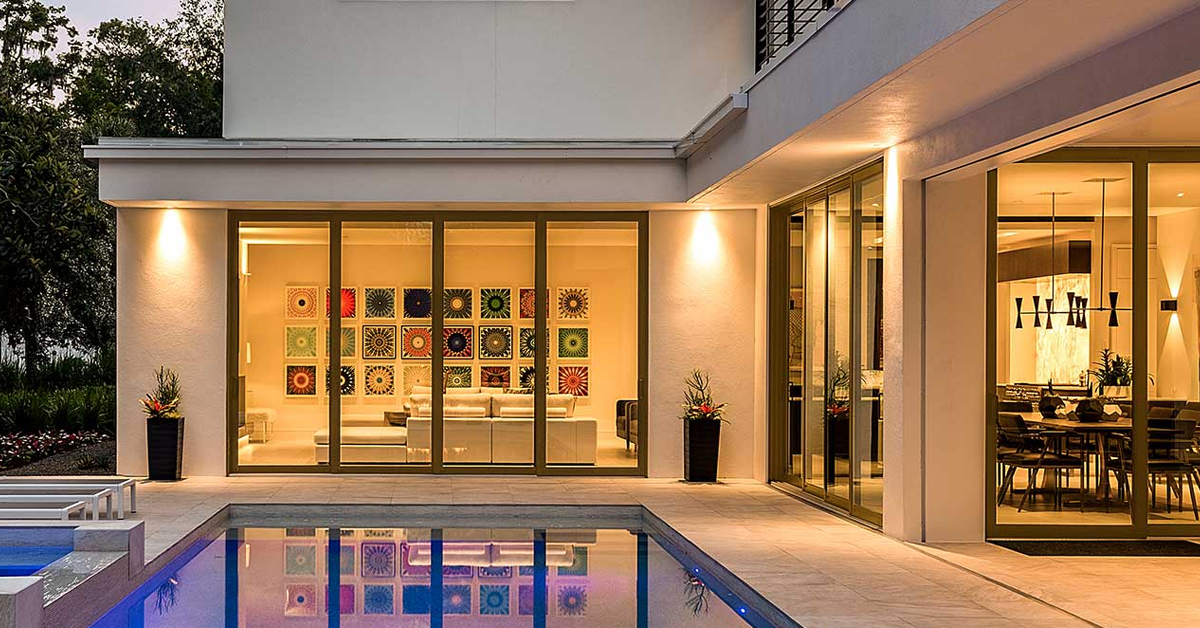
Two things separate it from an ordinary French door. The glass is laminated, so it holds together under impact instead of leaving a hole. And the whole door, glass, frame, and anchors, is tested and rated as one unit to Florida’s impact standards. Pair that with low-SHGC glass to keep the sun’s heat out, and a classic swinging door earns its place on a coastal Florida wall.
When you’re ready to pick one for your patio, we lay out the patio and sliding door options for Florida homes.
Key takeaways
- “Best” is criteria-based, not a single product. Impact rating, low SHGC, right sizing, and secure locking are the four things to check.
- In Florida’s cooling climate, SHGC leads. Aim for an SHGC around 0.25 or lower on sun-facing exposures; low glass ratings matter more than heating numbers.
- Impact-resistant sliding patio doors are tested to ASTM E1886 and E1996 and carry Florida Product Approval. They’re rated to hold together, not shatterproof, because laminated glass can still crack.
- Common sliding sizes are typical, not universal. AGW builds custom sliding doors, which matters for wide multi-panel openings.
- We install sliding and patio doors from PGT (including WinGuard), WinDoor, ESW, Euro-Wall, and Marvin (Ultimate and Elevate).
What is the standard patio door size?
There’s no single standard, only common sizes, and Florida homes push past them all the time. A two-panel sliding glass door commonly runs about 60, 72, or 96 inches wide (5, 6, or 8 feet) with a height of 80 inches (6 feet 8 inches) or 96 inches (8 feet). Eighty inches is the most common height. Three-panel units commonly run up to about 12 feet wide, and larger multi-panel configurations go wider still.
| Configuration | Common widths | Common heights |
|---|---|---|
| Two-panel slider | 60, 72, or 96 in (5, 6, or 8 ft) | 80 in (most common) or 96 in |
| Three-panel slider | up to ~144 in (12 ft) | 80 in or 96 in |
The friction shows up on the wide openings. Plenty of Florida homeowners want a wall of glass on the lanai, three or four panels across, and two things hit at once: the wider the span, the higher the wind load and the design pressure the door has to carry, and a span that wide almost never falls within a stock size. That’s why All Glass & Windows offers custom sliding doors. On a coastal opening, you want a door engineered for the span and the exposure in front of it, not a catalog size wrestled into the hole.
What are the best patio doors for a Florida home? Start with impact rating
Impact glass is laminated: two plies of glass bonded to an interlayer so the panel acts as one piece. Hit it hard enough, and it can still crack, but the fragments stay stuck to the interlayer, which resists penetration and keeps the opening intact against wind and debris. FEMA calls laminated glass “the preferred glazing material for new construction.” We don’t call it shatterproof because it isn’t. It’s laminated glass designed to hold together and stay in the frame.
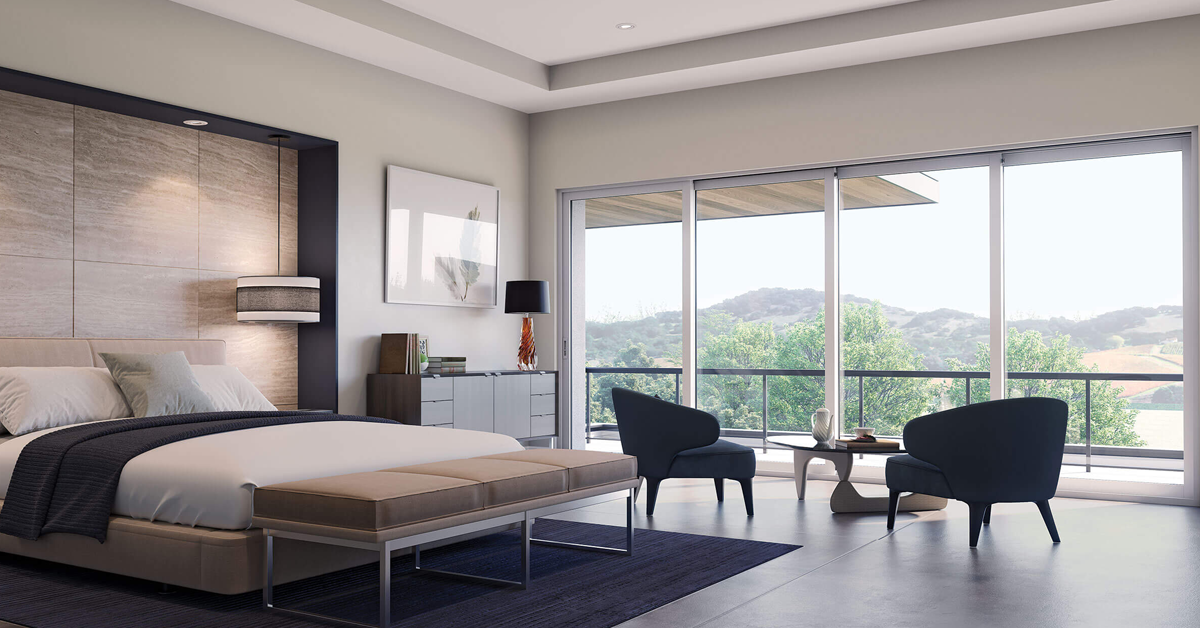
The rating is based on testing the entire door as a system. Impact-resistant sliding doors are tested to ASTM E1886 (the method) and ASTM E1996 (the specification), and the assembly is approved for use in our area under Florida Product Approval. The large-missile test fires a nine-pound two-by-four at the door, then follows with cyclic wind-pressure loading. Glass, frame, rollers, anchors, and installation pass or fail together.
Two ratings people mix up: Design Pressure (DP) rates the structural wind load the door is engineered to withstand; impact rating is a separate qualification for resisting flying debris. A good Florida patio door often carries both. And if your property sits in a wind-borne debris region, the Florida Building Code requires impact-resistant glazing or approved protection, so pull that for your specific address before you shop.
For a product-specific look at one of the sliding lines we install most, see our guide to PGT sliding glass doors. And if you’re after that wide-open, wraparound look, our page on corner sliding glass doors covers the 90-degree configuration.
Energy-efficient patio doors: SHGC leads in Florida
The second criterion is the glass ratings, and in our climate, SHGC comes first.
SHGC (Solar Heat Gain Coefficient) is the fraction of solar radiation the door admits, on a scale of 0 to 1. Lower means less solar heat comes through. The U.S. Department of Energy puts it plainly: “A product with a low SHGC rating is more effective at reducing cooling loads during the summer by blocking heat gain from the sun,” and “Low SHGCs reduce heat gain in warm climates.” Florida is cooling-dominated, so SHGC is the most important number. For sun-facing exposures, we recommend an SHGC of around 0.25 or lower. U-factor, the conductive heat-flow rate, is the second number; lower is more efficient, but it just doesn’t lead here.
Sliding glass doors are often rated under window criteria, since they carry window-type product codes. To earn ENERGY STAR in Florida’s Southern zone (Sarasota is confirmed Southern), the window criteria are a U-factor of 0.32 or lower and an SHGC of 0.23 or lower. A glass door rated under the door criteria (more than half-lite) must have a U-factor of 0.28 or lower and an SHGC of 0.23 or lower. Those are the certification thresholds a product has to meet to carry the label, not a guarantee for any one door. Low-E coatings are how manufacturers reduce SHGC without darkening the glass.
| Path a door is rated under | ENERGY STAR Southern-zone threshold |
|---|---|
| Window criteria (many sliding glass doors) | U-factor 0.32 or lower, SHGC 0.23 or lower |
| Door criteria (glass, more than half-lite) | U-factor 0.28 or lower, SHGC 0.23 or lower |
How to secure patio doors
Securing a sliding door comes down to the glass and the lock working together.
- Start with laminated impact glass. A laminated impact door already provides real security. Because the fragments remain adhered to the interlayer, the panel resists forced entry as it resists debris. Someone can crack the glass, but the interlayer keeps it hanging together, which makes it a slow, loud thing to break through rather than a quick smash-and-reach. That’s a mechanistic benefit of laminated glass, not a guarantee against a determined break-in.
- Add multi-point locking. Better sliding doors use multi-point locking, where the handle throws several locking points into the frame at once instead of a single latch. More engagement points along the panel means fewer weak spots. Again, that’s how the hardware works, not a promise, but it’s a real improvement over an old single-point slider latch.
- Check the strike and the anchoring. The locking points only do their job if the door is anchored to the frame and the strikes are engaged properly, which is part of a good install, not something you add later.
Laminated glass plus multi-point locking is the combination we point people to when security is the priority.
How to insulate sliding glass patio doors
Insulating a sliding door in Florida is less about stuffing in insulation and more about stopping air movement. The number to know is the air-leakage rating: the rate of air moving around the door under a given pressure difference. Lower is tighter. It’s an NFRC-rated metric, and the official rating assumes the door is installed properly, which is a reminder that a tight door installed loosely isn’t tight.
- Read the air-leakage rating first. Compare the NFRC air-leakage number on the products you’re weighing. Lower is tighter, and it’s the metric that tells you how well a door holds out air movement before you ever install it.
- Inspect and renew the weatherstripping. On a slider, the panel glides on a track, so the seals along the track and at the panel joints keep conditioned air in and humid outside air out. When we replace an old slider, worn or missing weatherstripping is usually a major reason the old one felt drafty.
- Confirm a clean, tight install. A door with good factory weatherstripping still needs a square, properly sealed install to hit its rated air-leakage number. A tight door that is installed loosely isn’t tight.
- Keep the track’s weep drains clear. A sliding door track has weep channels that drain windblown rain back outside. Those have to stay clear, especially on coastal homes, or water backs up in the track. It’s a maintenance point that ties into the salt-air issue below.
Where patio doors get tricky in Florida homes
A few realities come up on almost every coastal sliding-door job.
The wide openings, again. The more glass you span, the more wind load the door carries, and the more the DP rating earns its keep. A wall of glass on a west-facing coastal exposure is a different engineering problem than a modest two-panel slider tucked on the protected side of the house.
Then there’s salt air. On the barrier islands and anywhere close to the water, it goes after hardware and rollers first, which is why the metal, the finish, and the rolling gear matter as much as the glass. A slider that starts to bind after a couple of seasons is usually a corrosion story.
And the track has to keep draining. The weep system down in the track carries windblown rain back outside, and it has to stay clear, near the water especially. That’s the line between rain draining out and rain pooling where it shouldn’t.
The brands we install for patio and sliding doors
We install sliding and patio doors from makers we trust for Florida coastal work: PGT (including WinGuard), WinDoor, ESW, Euro-Wall, and Marvin (Ultimate and Elevate). These are the brands we’d install in our own homes, and the right one depends on the width of your opening, your exposure, and the configuration you want.
If a hinged pair is still in the running, impact French doors for Florida covers that side, and the French doors versus sliding patio doors head-to-head lay out the trade-offs. Both sit under the exterior doors of a Florida home for a general overview.
On the protective side, see our impact windows and doors solutions; for the ratings that drive comfort and cost, see energy-efficient windows and doors.
Patio door questions Florida homeowners ask
There’s no single best model. In a cooling climate like Florida’s, the best patio door is one with low SHGC glass (aim around 0.25 or lower on sun-facing exposures) plus an impact rating for wind and debris, sized right for your opening and fitted with secure multi-point locking. Match those criteria and you’ve matched the door to the home.
They can be, when they’re built with laminated impact glass and tested as an assembly to ASTM E1886 and E1996, then approved through Florida Product Approval. We don’t call them shatterproof or hurricane-proof. The laminated glass is designed to hold together and resist penetration so the opening stays intact.
Focus on stopping air movement. Look at the air-leakage rating (lower is tighter), and make sure the weatherstripping and track seals are in good shape. Worn weatherstripping is usually why an old slider feels drafty. Keep the track’s weep drains clear so windblown rain drains back outside instead of pooling.
Two things together: laminated impact glass, which resists forced entry because the fragments stay bonded to the interlayer, and multi-point locking, which throws several locking points into the frame instead of one. Neither is a guarantee, but together they make a slider much harder to get through.
There’s no universal standard, only common sizes. Two-panel sliders commonly run 60, 72, or 96 inches wide and 80 inches tall (96 inches for taller units), and three-panel units run up to about 12 feet wide. Because Florida openings often go wider than stock, All Glass & Windows offers custom sliding doors.
Ready to choose the right patio door?
If you’re weighing patio doors for a Sarasota, barrier-island, Lakewood Ranch, Bradenton, Osprey, or St. Petersburg home, we can help you line up the impact rating, the glass ratings, the sizing, and the locking against your actual opening and exposure. All Glass & Windows has sold, installed, and serviced impact windows and doors since 2009, and we build custom sliding doors for the wide openings that Florida homes often feature.
For pricing, request a quote, and we’ll put real numbers to your project. If you’d like to slide a door open and feel the hardware before you decide, our showroom is set up for that by appointment, Monday to Friday, 8:00 am to 4:30 pm. Reach out, and we’ll figure out the right next step together.