
When homeowners ask about energy-efficient front doors, they are usually asking about a different product than energy-efficient windows or sliding glass doors. A front door is mostly a solid panel, not glass. The energy performance comes primarily from the door’s core, its weatherstripping, and how tightly it seals to the frame. Glass inserts and sidelights matter too, but they are secondary considerations, not the primary ones.
This matters because most of what you read online about “energy-efficient doors” gets mixed up with patio doors, French doors, and sliders. The advice is different for a front entry door, especially in a Florida coastal home.
Here is what we walk homeowners through when they come into the showroom asking about replacing their front entry door.
What Makes a Front Door Energy Efficient
Four things determine how a front entry door performs thermally:
The door’s core material. A fiberglass door with a polyurethane foam core insulates much better than a solid wood door. An insulated steel door with a dense foam core also performs well. A hollow-wood door, common in older Florida homes, is one of the worst performers.
The weatherstripping and door sweep. The seal between the door and the frame is where most energy is lost on a front door. Compression weatherstripping around the perimeter and a quality door sweep at the bottom make or break the real-world performance.
The threshold and sill. A well-designed threshold creates a tight seal at the bottom of the door. Older homes often have thresholds that have settled, warped, or never been sealed well in the first place. This is a common hidden source of air leakage.
Any glass inserts, sidelights, and transoms. If the door has glass components, the glass package matters. Low-E coatings, insulated glass units, and argon gas fills all help, just as on a window. For a door with a significant glass area, this becomes more important.
All four matter. The best-insulated door panel will still perform poorly if the weatherstripping is cheap or the threshold is out of adjustment. This is why installation quality matters as much as the product itself.
Energy Performance Ratings to Look For
When comparing front entry doors, the ratings that matter are the same ones that apply to windows:
U-factor. Measures how well the door insulates against heat transfer. Lower is better. For front doors, look for a U-factor of 0.30 or lower for the full door system (not just the panel).
Solar Heat Gain Coefficient (SHGC). Measures how much solar heat passes through the glass portions of the door. For Florida homes, lower is better. Look for SHGC in the 0.25 range or below on sun-facing entries. For solid-panel doors with no glass, this rating is less relevant.
Air Leakage (AL). Measures how much air passes around the door when closed. This is the most important rating for a front entry door because the seal quality determines so much of real-world performance.
ENERGY STAR certification. Doors that carry ENERGY STAR certification meet federal efficiency criteria for the climate zone. Most of Florida falls within the Southern zone, which has different criteria from the Northern zone. A door certified for Minnesota is not automatically the right door for Sarasota.
The NFRC label on the door will show all of these ratings. Look for the label on any door you are comparing, and ignore marketing claims that are not backed by NFRC numbers.
Material Options for Energy-Efficient Front Doors
Four main material categories for front entry doors, each with different performance characteristics in Florida:
Fiberglass Doors
Fiberglass is the strongest all-around performer for Florida front entry doors. The material has excellent thermal properties, does not corrode in salt air, does not warp in humidity, and can be molded to look like wood grain or finished smooth.
The core matters as much as the skin. A fiberglass door with a polyurethane foam core insulates significantly better than one with a polystyrene core. Premium fiberglass doors from manufacturers like Kolbe or Marvin use quality foam cores that deliver real R-value.
Pros:
- Strong thermal performance
- Dimensionally stable in heat and humidity
- No corrosion, warping, or rot
- Available in textured wood-grain or smooth finishes
- Paintable in any color
Cons:
- Premium pricing compared to steel or vinyl
- Aesthetic is less traditional than wood
For most Sarasota-area homeowners, fiberglass is the recommendation when the priority is long-term performance and low maintenance.
Insulated Steel Doors
Insulated steel doors have a foam core sandwiched between steel panels. They offer good thermal performance at a lower price point than fiberglass and provide excellent security.
Pros:
- Strong insulation value with quality foam core
- Good security, since steel is harder to force than wood or vinyl
- Lower cost than fiberglass or wood
- Magnetic weatherstripping creates a tight seal
Cons:
- Can dent from impact (unlike fiberglass)
- Steel can show wear in coastal salt air over time without the right finish
- Paint can chip or fade faster than fiberglass finishes
- Thermal bridging occurs when steel spans the full door thickness, if the door is not properly designed with a thermal break
Steel is a good middle-ground option, especially for homes not directly on the water, where salt air corrosion is less aggressive.
Wood Doors
Solid wood doors offer the most traditional aesthetic but the weakest thermal performance of the major options. Wood is a natural insulator, but solid wood is not as insulating as an insulated fiberglass or steel door with a quality foam core.
Pros:
- Classic aesthetic, warm appearance
- Available in many species, stains, and finishes
- Can be custom-built in any size or design
- Repairable if damaged
Cons:
- Weakest thermal performance of the common options
- The highest maintenance requirement in Florida humidity
- Can warp, swell, or split over time if not properly maintained
- More susceptible to moisture damage in coastal environments
For homeowners committed to the look of real wood, consider a wood door with insulated glass inserts and a good weatherstripping package. Accept that it will need refinishing more often than fiberglass or steel.
Vinyl and Composite Doors
Vinyl front doors exist but are uncommon compared to vinyl on windows and sliding doors. Composite doors, sometimes combining wood cores with fiberglass or vinyl skins, are more common in the entry door category.
Pros:
- Lower cost than premium options
- Resistant to moisture
- Low maintenance
Cons:
- Limited aesthetic options
- Weaker mid-grade performance compared to fiberglass
- Frame profiles can look less refined
Not usually the first recommendation for a front entry door unless budget is the primary constraint.
Front Door Glass: When It Matters and When It Does Not
Many front doors include some amount of glass, whether small windows, half-light inserts, three-quarter-light inserts, or full-glass panels. Sidelights and transoms add even more glass area.
The more glass a front door has, the more the glass package matters for energy performance. A solid fiberglass door without glass has essentially no glass-related performance issues. A front door with a full-glass panel and two sidelights is, in effect, a glass door system, and the glass package matters as much as the panel.
For front doors with significant glass:
- Insist on Low-E glass in the insulated glass unit. For more on why this matters in Florida, see our guide to Low-E glass.
- Look for argon gas fill between the glass panes for better insulation.
- Consider the frame material of the glass inserts. Some budget doors use wood or steel around the glass that creates thermal bridging. Quality doors use insulating spacers.
- Factor in the orientation. West-facing entries with lots of glass take the worst solar load in Florida. A quality glass package matters more for these entries.
For front doors with minimal glass, the panel, weatherstripping, and threshold matter more than the glass itself.
Brands We Install for Front Entry Doors
In the Sarasota area, the manufacturers we install most often for front entry doors include:
- Marvin: The Ultimate and Elevate lines include fiberglass and wood-clad entry door options with strong thermal performance.
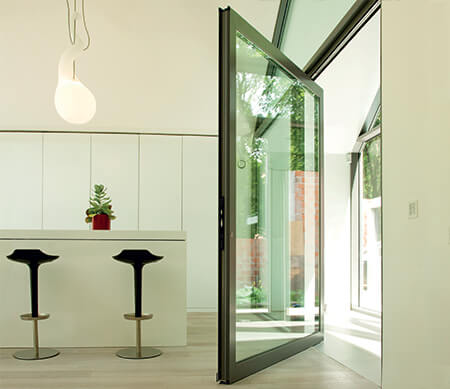
- Kolbe: Premium wood and wood-clad entry doors with extensive customization, including the VistaLuxe pivot door for architectural applications.
- Signature: Custom configurations including operable sidelights, which are useful for Florida entries where you want ventilation without the full door open.
- PGT: Impact-rated entry door options for homes requiring hurricane protection.
- WinDoor: Aluminum entry door systems for modern coastal homes, including impact-rated configurations.
The right brand depends on the project: budget, aesthetic, whether hurricane protection is required, and the amount of glass in the door. Part of what we do is walk through the trade-offs without pushing one brand.
Hurricane Protection and Front Doors in Florida
In most of the Sarasota area, front entry doors need to meet Florida Building Code requirements for wind pressure and, in many locations, windborne debris impact. For a solid-panel door, this usually means:
- Reinforced frame and hardware engineered to withstand design pressure loads
- Impact-rated glass if the door has any glass components
- Approved installation method with proper anchoring and sealing per Florida Product Approval
If your front door has glass panels, sidelights, or a transom, those components need an impact rating in addition to the door panel itself. A door approved without glass may not be approved once you add sidelights to the opening. Confirm that the specific configuration has the required approvals for your location.
For a broader overview of hurricane protection for windows and doors, see our hurricane windows page or impact windows page.
Sidelights, Transoms, and Storm Doors
A few related components that affect energy performance:
Sidelights are vertical glass panels flanking the front door. They add width, light, and visual weight, as well as glass area. In Florida, that means more solar heat gain on sun-facing entries. If you are adding sidelights, insist on Low-E insulated glass with argon fill. Some manufacturers offer operable sidelights that can be opened for ventilation, which is useful for Florida-covered entries.
Transoms are horizontal glass panels above the door. They add height and light, useful for tall entries. Energy considerations are the same as for sidelights.
Storm doors are secondary doors installed in front of the main entry door. They can improve thermal performance on older entry doors by adding an extra air gap and a second weather barrier. For new high-performance doors, a storm door is usually unnecessary and can actually trap heat against the primary door, potentially damaging finishes over time. Not recommended for a new fiberglass or insulated steel entry door in Florida.
Installation Matters More Than Most Homeowners Expect
A high-performing front entry door installed poorly will leak air around the frame, no matter how good the door itself is. Installation is where most real-world performance is made or lost.
Read more about energy efficient windows and doors.
A proper front door installation in a Sarasota-area home involves:
- Confirming the rough opening is square and plumb. Older homes often have openings that have shifted over time.
- Proper flashing around the opening to prevent water intrusion.
- Correct shimming and anchoring per the manufacturer’s specifications.
- Quality sealant at the perimeter to prevent air and water leakage.
- Adjust the threshold and weatherstripping after installation so the door closes with even compression around the entire perimeter.
For coastal homes, stainless steel or hot-dipped galvanized fasteners are also important, as standard fasteners can corrode over time in salt air.
Federal Tax Credits for Energy-Efficient Doors
The Energy Efficient Home Improvement Credit is currently available for qualifying ENERGY STAR-certified exterior doors. The credit has specific annual limits for doors and requires the product to meet specific ENERGY STAR criteria.
Credits change, so confirm current eligibility and limits at energystar.gov/federal-tax-credits before planning.
When Replacement Is Worth It
Signs that replacing your front entry door makes sense:
- Visible daylight around the door when closed. Air and water are getting in.
- Drafts near the door on windy days. Seal failure somewhere.
- Hot or cold spots in the entry area that do not match the rest of the house.
- The door sticks, rubs, or no longer closes tightly. Frame shift or door warp.
- Paint peeling, wood rot, or hardware corrosion. Material failure.
- The door is original to a home more than twenty years old, with no evidence of quality construction. Older doors often lack modern insulation cores.
For homes with newer, well-maintained doors, the return on replacement is slower. In those cases, addressing specific issues like weatherstripping, threshold adjustment, or a storm door on an older entry often makes more sense than a full replacement.
See also: glass front doors.
Front Door FAQs for Florida Homeowners
For most Florida homes, fiberglass with a polyurethane foam core offers the best combination of thermal performance, weather resistance, and durability. Insulated steel is a strong second choice at a lower price point. Solid wood is the least insulating of the common options, though it can still perform adequately with a quality weatherstripping package.
Yes, especially in a cooling-dominant climate like Florida. ENERGY STAR-certified doors meet federal efficiency criteria for the climate zone and typically include quality weatherstripping, insulated cores, and proper glass packages where applicable. The certification is a useful baseline indicator of a door that will perform well in real-world use.
Exact waste depends on the door, the opening condition, and the climate. In a Florida home, a poorly sealed front entry door can let conditioned air escape and let hot, humid air enter whenever the wind blows against it. The cumulative effect over a cooling season is noticeable on the electric bill and on comfort near the entry area.
Depends on the door’s age and condition. If the door itself is structurally sound and the air leakage is coming from worn weatherstripping or a misaligned threshold, replacing those components is often enough. If the door has structural issues, rot, warping, or an outdated insulation core, a full replacement delivers longer-lasting performance.
For thermal performance, low maintenance, and resistance to humidity and salt air, yes. Fiberglass is typically the better choice for coastal homes in Florida. Wood offers a warmer traditional aesthetic but requires more maintenance in our climate and offers weaker insulation. If you want the look of wood with the performance of fiberglass, many manufacturers now offer fiberglass doors with convincing wood-grain textures.
Yes, but not necessarily significantly. A front door with a high-quality Low-E-insulated glass insert performs well. A front door with cheap single-pane glass or a failed insulated glass unit is where the real performance losses happen. The issue is the quality of the glass package, not the presence of glass itself.
Yes. Many impact-rated front doors also carry ENERGY STAR certification for the Southern climate zone. Laminated impact glass has some insulating benefit built in, and manufacturers design impact-rated frames with proper thermal breaks and weatherstripping. The two features are not mutually exclusive.
A storm door is a secondary door installed in front of the main entry door. On older, underperforming entry doors, a storm door can improve thermal performance by adding an extra air gap. On new high-performance fiberglass or insulated steel doors, a storm door is usually unnecessary and can trap heat against the primary door, potentially damaging finishes over time.
The Energy Efficient Home Improvement Credit currently covers qualifying ENERGY STAR-certified exterior doors, subject to annual limits. Eligibility and limits change, so confirm the current rules at energystar.gov/federal-tax-credits before planning.
Yes. We work with homeowners, builders, architects, and designers on both replacement and new construction projects.
Ready to Compare Front Door Options?
If you are planning a front entry door project in the Sarasota area, we can walk through the opening conditions, material options, and performance trade-offs that apply to your specific home. For a broader picture of how front doors fit into overall energy strategy, see our energy-efficient windows and doors for Sarasota homes page.
For a measurement-based estimate, request a quote or call us at 941-379-9555.